I'm going to have to go on a short break from writing. I will try and post something up when i can, but dont hold your breaths.
At least this time im giving warning, rather than disappearing for two months...
Monday, September 15, 2008


Friday, September 5, 2008
Long awaited
Finally a new post!
But enough navel-gazing, the world is in trouble.
What? You hadn't noticed? It's fair enough, not many have. Of course everyone kind of knows about climate change (everyone who isn't willfully ignorant about it), most people have at least heard there are a number of wars going on, and a lot of people have at one point or another thought that if the poor-rich gap gets any bigger, we're all going to fall into it.
But how many people actually realize how bad things are?
The vast majority of people out there do not really realize how bad all of these problems really are and how, despite the best efforts of small numbers of dedicated people, these have only gotten worse and will continue to do so.
"But Razboz, i hear you whine, you aren't really offering any new solution! It's clear that the problems we have today are grave, but solutions already exist, we just need to implement them! For example I've stopped taking the car to work and I give money to UNICEF!"
Of course you wouldn't actually say that because there are too many multisyllabic words in that sentence, but if you did the first thing I'd mention is how stupid you are to buy into the cynical lies that has been perpetrated against the peoples of the world.
This lie is that all of us, one by one, by changing our way of life can change the climate and help solve poverty.
I can hear all of you caviar-greens and salmon-reds (yes that is a kind of pink) complaining and whining from here.
First off: shut up. If your way could work we wouldn't be in this increasing mess. That we can all do our bit and that changing our lifestyles will change the climate is simply the way that corporations and governments have found to placate the pressing need for profound change. Indeed if we really did what we needed to do to change our way of life, and by extension our modes of production, transport and governance these people in their cushy (leather) sofas would lose what they prise most: their power.
These elites, which govern the world through force and disinformation, need people to believe that with an introspective approach, one of self-change before global change, there will actually be an important change. This works well for them: it gives them the opportunity to sell the washed and white-collared masses expensive solutions, like hybrid cars, new power plants and funky little gizmos that can play the radio and have a flashlight and need only be cranked to provide power. The people who can afford this feel they've solved the problem, and those who cant feel guilty for not being able to.
In short by buying into the idea that we can all do our bit, by contributing to these corporate and government led environmental and social efforts we are buying into the very system that caused these problems in the first place. Now if this system had ever given any indication that it can be successfully harnessed by good people to do good things, then following these efforts would be, if not acceptable, at least an interesting alternative. As things stand the system is out of the control of any government or corporate interest. It is out of the control of any group, NGO or otherwise, and will always remain that way.
These are big statements to make, and stand in the face of "conventional" wisdom. Indeed the implications of all of this is that we as the people of the world cannot solve anything by subscribing to any solution that works within the system. This is slightly unfair, but on the whole true. For charities and releif efforts prolong the pain caused by a system which in its nature involves brutal, cold competition as the basic mechanism for survival. Even as Oxfam or MSF cure and feed the sick and the starving, the tireless cogs of capitalism ar grinding into the dirt countless others. Thanks to these temporary patches, the system lives on, mantaining the illusion that we can all do our bit, and that things will soon be OK.
The world is in trouble, and we need to stop buying into their lies.
The world is in trouble and we need a revolution.
But enough navel-gazing, the world is in trouble.
What? You hadn't noticed? It's fair enough, not many have. Of course everyone kind of knows about climate change (everyone who isn't willfully ignorant about it), most people have at least heard there are a number of wars going on, and a lot of people have at one point or another thought that if the poor-rich gap gets any bigger, we're all going to fall into it.
But how many people actually realize how bad things are?
The vast majority of people out there do not really realize how bad all of these problems really are and how, despite the best efforts of small numbers of dedicated people, these have only gotten worse and will continue to do so.
"But Razboz, i hear you whine, you aren't really offering any new solution! It's clear that the problems we have today are grave, but solutions already exist, we just need to implement them! For example I've stopped taking the car to work and I give money to UNICEF!"
Of course you wouldn't actually say that because there are too many multisyllabic words in that sentence, but if you did the first thing I'd mention is how stupid you are to buy into the cynical lies that has been perpetrated against the peoples of the world.
This lie is that all of us, one by one, by changing our way of life can change the climate and help solve poverty.
I can hear all of you caviar-greens and salmon-reds (yes that is a kind of pink) complaining and whining from here.
First off: shut up. If your way could work we wouldn't be in this increasing mess. That we can all do our bit and that changing our lifestyles will change the climate is simply the way that corporations and governments have found to placate the pressing need for profound change. Indeed if we really did what we needed to do to change our way of life, and by extension our modes of production, transport and governance these people in their cushy (leather) sofas would lose what they prise most: their power.
These elites, which govern the world through force and disinformation, need people to believe that with an introspective approach, one of self-change before global change, there will actually be an important change. This works well for them: it gives them the opportunity to sell the washed and white-collared masses expensive solutions, like hybrid cars, new power plants and funky little gizmos that can play the radio and have a flashlight and need only be cranked to provide power. The people who can afford this feel they've solved the problem, and those who cant feel guilty for not being able to.
In short by buying into the idea that we can all do our bit, by contributing to these corporate and government led environmental and social efforts we are buying into the very system that caused these problems in the first place. Now if this system had ever given any indication that it can be successfully harnessed by good people to do good things, then following these efforts would be, if not acceptable, at least an interesting alternative. As things stand the system is out of the control of any government or corporate interest. It is out of the control of any group, NGO or otherwise, and will always remain that way.
These are big statements to make, and stand in the face of "conventional" wisdom. Indeed the implications of all of this is that we as the people of the world cannot solve anything by subscribing to any solution that works within the system. This is slightly unfair, but on the whole true. For charities and releif efforts prolong the pain caused by a system which in its nature involves brutal, cold competition as the basic mechanism for survival. Even as Oxfam or MSF cure and feed the sick and the starving, the tireless cogs of capitalism ar grinding into the dirt countless others. Thanks to these temporary patches, the system lives on, mantaining the illusion that we can all do our bit, and that things will soon be OK.
The world is in trouble, and we need to stop buying into their lies.
The world is in trouble and we need a revolution.
Friday, July 18, 2008
Still Here
future I realise no one actually reads this blog, as my deppressingly double digited hit counter to the right might tell you. I just wanted to say that i am, in fact, still alive and i hope to be posting in the near future with some exciting new projects and/or the announcement of the end of capitalism and the begining of the world revolution.
But more likely only exciting new projects and ideas to kill the time during your petit-bourgeois summer holidays.
Keep the homefront safe and see you next week.
But more likely only exciting new projects and ideas to kill the time during your petit-bourgeois summer holidays.
Keep the homefront safe and see you next week.
Monday, June 2, 2008


Saturday, May 24, 2008
Friday, May 23, 2008
Thursday, May 22, 2008

Wednesday, May 21, 2008
Tuesday, May 20, 2008
Monday, May 19, 2008

Sunday, May 18, 2008
A Comfortable Arsenal
To follow up on my previous post i give you what i hope will be a regular feature on the Homefront of the Revolution: My arsenal of weaponised linguistic products for you and your friends to help destroy the state and capitalism.
I thought i'd begin my stockpile with some words that can really be used by the revolutionary, a practical sense. The page was created in expectation of Black Bloc action during the IMF/World Bank meeting in Washington DC, on September 30th 2001. The author of the website was detained and given 1 year in jail in the United States. Find the texts divided into different categories here
Next up is more of a general resource for your litterary needs, but nontheless carries a great deal of very important information: Wikisource. Wikisource compiles books and texts, most of which are past their copyright. Most of them are also out of print, or available only to academics. THanks to wikisource you can read books that up until recently only very few had access to. A few i could recomend begining by are Bakunin and Thoreau, though you can find the works of any number of authors.
more next week
I thought i'd begin my stockpile with some words that can really be used by the revolutionary, a practical sense. The page was created in expectation of Black Bloc action during the IMF/World Bank meeting in Washington DC, on September 30th 2001. The author of the website was detained and given 1 year in jail in the United States. Find the texts divided into different categories here
Next up is more of a general resource for your litterary needs, but nontheless carries a great deal of very important information: Wikisource. Wikisource compiles books and texts, most of which are past their copyright. Most of them are also out of print, or available only to academics. THanks to wikisource you can read books that up until recently only very few had access to. A few i could recomend begining by are Bakunin and Thoreau, though you can find the works of any number of authors.
more next week
Words are our first step towards freedom.
A while ago I worked on a newspaper that ran in my school for a year and a bit. It was a pretty good newspaper, as far as student generated newspapers go. It was feircely anti-establishment, and mostly focused on leftist, or leftist oriented politics. Thanks to the mix of political opinions in the writting team it somehow managed avoiding sounding preachy and annoying. All good things come to an end, and sometimes also the bad ones. The newspaper disapeared as the folks (including me) who wrote it drifted off to wherever it was their lives led them.
For a while i though nothing more of Rioter's Block. As a matter of fact i though nothing more of alternative journalism in general. Then i picked up a newspaper called Machetarte.
Words are deceptively weak. We use them everyday to do everyday things. We use them to ask for directions, a sandwich, a drink, forgiveness. Like farm tools we use them to provide for ourselves. Thanks to our words we obtain our daily bread. But like farm tools, words can be quickly turned into weapons. What we once use to get a train ticket, or the time of day, we then use to strike out at those that threaten us in some way. But like the everyday violence committed using pitchforks, machetes or scythes, most of the the violence exerted using everyday words in our everyday setting is useless.
Machetearte is your very typical, run-of-the-mill leftist newspaper. The very paper reeks of the righteous outrage of some greasy haired young socialist typing away in a basement, or the self-centered ramblings of some grey-haired syndicalist. Like the crushing majority of leftist litterature (and unfortunately a large aprt of revolutionary litterature too) it is tedious and self-refferential. Unless one is intimately acquainted with the intricacies of the workings of some union, or the exact circumstances of such-and-such demontration, or the political and historical precedent for the petty little battle between one trotskyte group and another, the newspaper is entirely worthless to the common person. What it aims to do is tell people of the opinions, or tell people of the pet-peeve of the author.
Words, like farm-tools, have no purpose other than to be used. The purpose of the scythe is not to help the farmer reap, as the purpose of a word is not to overthrow the state. Tools only hold the purpose that their users give them. A machete can become a weapon, when the peasant slices the land-owner's throat; just as words can become weapons, when the revolutionary uses them to share his own thoughts with the world.
Reading a text that comes from outside the established media institutions is a breath of fresh air. Indeed a vital breath of fresh air. Without this essential input from those who do not operate within the powerful news conglomerates, the mind becomes stale and rotten. The incestuous relationship that news-outlets havebetween themselves has produced a homogoneous landscape throughout the world.
Reading Mechetearte made me realise that most people use words the same way they were taught to use words. As means of procuring daily bread, or of simply showing something to someone. Most people use words the same way or ape-like ancestors did when they were still learining hwo to use opposable thumbs: simply as tools to fullfill needs within the community. Simply put: we are using words to get bananas and show people where to get more. Fortunately most of the human race has evolved a little and words are now being used as powerful weapons to change the way people think. Why is it then, that next to no-one is taught how to do this? Why is it that when persuasive writing is involved it almost always serves the basic necessity of getting a job? Why is it that the best and brightest persuaders work for the capitalist? Why is it that people have failed to weaponize their vocabulary?
Words like almost every other powerful weapon in mankind's arsenal are used to subjugate and control the masses. Words are what the media use to carefully control the way they present the "facts". This is the most powerful tool that the modern economic tyrants use to exert their control over the masses. Should revolutionary, or unstable elements of the populace get their hands on this weapon, the subtle and powerful control that the powerful have on the weak would be forever broken. With the ability to influence the way people think about power, wealth and capitalism revolutionaries would acheive their ends. With effective control over the power of words, as well as a coherent view of reality to support this power very little could stand in the way of the revolution.
To weaponise a tool takes only two things. Intent and ability. Many people have the intent but lack the ability to aply this intent to the tool. And this is exactly what the powerful want.
Words are deceptively weak, because we are deceived into thinking they are.
Words are the only weapon of those wihtout the recources to make bombs, without the numbers to stage a revolution. Words are the main weapon of the poor and disenfranchised. Words are our first step towards freedom.
I was wrong to give up on the power of words. I encourage everyone to take a language class, to learn more about words. I encourage everyone to place their thoughts into letters, words, sentences, paragraphs: manifestos written by each and every one of us. Most importantly give your words intention, life, movement: give your words power.
For a while i though nothing more of Rioter's Block. As a matter of fact i though nothing more of alternative journalism in general. Then i picked up a newspaper called Machetarte.
Words are deceptively weak. We use them everyday to do everyday things. We use them to ask for directions, a sandwich, a drink, forgiveness. Like farm tools we use them to provide for ourselves. Thanks to our words we obtain our daily bread. But like farm tools, words can be quickly turned into weapons. What we once use to get a train ticket, or the time of day, we then use to strike out at those that threaten us in some way. But like the everyday violence committed using pitchforks, machetes or scythes, most of the the violence exerted using everyday words in our everyday setting is useless.
Machetearte is your very typical, run-of-the-mill leftist newspaper. The very paper reeks of the righteous outrage of some greasy haired young socialist typing away in a basement, or the self-centered ramblings of some grey-haired syndicalist. Like the crushing majority of leftist litterature (and unfortunately a large aprt of revolutionary litterature too) it is tedious and self-refferential. Unless one is intimately acquainted with the intricacies of the workings of some union, or the exact circumstances of such-and-such demontration, or the political and historical precedent for the petty little battle between one trotskyte group and another, the newspaper is entirely worthless to the common person. What it aims to do is tell people of the opinions, or tell people of the pet-peeve of the author.
Words, like farm-tools, have no purpose other than to be used. The purpose of the scythe is not to help the farmer reap, as the purpose of a word is not to overthrow the state. Tools only hold the purpose that their users give them. A machete can become a weapon, when the peasant slices the land-owner's throat; just as words can become weapons, when the revolutionary uses them to share his own thoughts with the world.
Reading a text that comes from outside the established media institutions is a breath of fresh air. Indeed a vital breath of fresh air. Without this essential input from those who do not operate within the powerful news conglomerates, the mind becomes stale and rotten. The incestuous relationship that news-outlets havebetween themselves has produced a homogoneous landscape throughout the world.
Reading Mechetearte made me realise that most people use words the same way they were taught to use words. As means of procuring daily bread, or of simply showing something to someone. Most people use words the same way or ape-like ancestors did when they were still learining hwo to use opposable thumbs: simply as tools to fullfill needs within the community. Simply put: we are using words to get bananas and show people where to get more. Fortunately most of the human race has evolved a little and words are now being used as powerful weapons to change the way people think. Why is it then, that next to no-one is taught how to do this? Why is it that when persuasive writing is involved it almost always serves the basic necessity of getting a job? Why is it that the best and brightest persuaders work for the capitalist? Why is it that people have failed to weaponize their vocabulary?

Words like almost every other powerful weapon in mankind's arsenal are used to subjugate and control the masses. Words are what the media use to carefully control the way they present the "facts". This is the most powerful tool that the modern economic tyrants use to exert their control over the masses. Should revolutionary, or unstable elements of the populace get their hands on this weapon, the subtle and powerful control that the powerful have on the weak would be forever broken. With the ability to influence the way people think about power, wealth and capitalism revolutionaries would acheive their ends. With effective control over the power of words, as well as a coherent view of reality to support this power very little could stand in the way of the revolution.
To weaponise a tool takes only two things. Intent and ability. Many people have the intent but lack the ability to aply this intent to the tool. And this is exactly what the powerful want.
Words are deceptively weak, because we are deceived into thinking they are.
Words are the only weapon of those wihtout the recources to make bombs, without the numbers to stage a revolution. Words are the main weapon of the poor and disenfranchised. Words are our first step towards freedom.
I was wrong to give up on the power of words. I encourage everyone to take a language class, to learn more about words. I encourage everyone to place their thoughts into letters, words, sentences, paragraphs: manifestos written by each and every one of us. Most importantly give your words intention, life, movement: give your words power.
Wednesday, May 7, 2008
Luz

Luz: Girl of the Knowing is a brilliant comic written and drawn by Claudia Dàvila. It relates the experiences of a girl trying to prepare for a post peak-oil world. The comic itself is full of neat ideas and solutions. However the real power of the comic is to make the problems of surviving in a world without oil or coal or natural gas much more real than mere theoretical considerations, entertained by scientists and used by politicians. It really brings home the dillemmas and sacrifices that we will have to face in order to live beyond the tyranny of oil. More than just a very cute comic fill of resources, Luz is really a wake up call to those who think these problems are far away, and the solutions unrealistic.
Wednesday, April 30, 2008
Time Has Run Out
We have come to a crossroads in history. From our choices and decisions at this precise point will depend the entire future of the human race. It is not hyperbolic to say that the wrong path will bring about an apocalypse. This is the path of accelerated self destruction. There is no exaggeration in the statement that humanity, all of us, every single individual on this planet, faces annihilation at our own hands.
This threat is one multi-headed beast. But one beast it is, and it has but one solution.
The first, and most dangerous, of these heads is the global depletion of fossil fuel reserves. Currently fossil fuels supply the overwhelming majority of our energy. Without basics supplies like electricity civilisation on every continent will fall apart into chaos, violence and death. This is not an option. In the best case scenario humanity will be reduced to thousands of minute primitive settlements. The information empire which we have built up, which has allowed us to cure millions of diseases, to double or even triple our life expectancy and that has allowed us to look into the very heart of the universe, all of this will be wiped out. The regression will send us back a thousand, two thousand or five thousand years, back to an age where every shadow still held certain death and man truly was the wolf of man. Along with actual wolves, and mammoths and aurochs and saber tooth tigers.
Once our coal, oil and natural gas supplies run out, this is the profoundly bleak future we are faced with. Nuclear power will allow the more powerful nations (the Western Europeans, Russians, Chinese, United States Americans, Indians and some select few) to struggle on, but society will be shattered. And then the Second Head will rear its mutated face: Nuclear waste will begin building up. maybe it will be exported to the energy-deficient third world: most of Africa, large parts of Asia, South America and Eastern Europe will be showered with radioactive snow. There they will cause disease and destruction. No safe method of very long term storage of nuclear waste exists: eventually every single ecosystem in the world will be contaminated to a large or small degree. Cancer will take the world by storm and humanity will begin to extinguish itself.
Perhaps bio-fuels will allow us to hold on a bit longer to our contrived way of life. Perhaps bio-fuels will mean that the rich will be able to fuel their SUVs for a few more decades. But eventually this will prove disastrous. This Third Head of the beast is the most insidious of all. Already bio-fuels have caused the increase in price of countless foods throughout the world such maize, palm oil and soy beans. These products form, in some way or another, the basic protein and fat supply of billions of poor throughout the world. Without these cheap crops many are going unfed. Already food riots are common in southeast Asia. Many of the urban poor are struggling to meet their needs in oils due to inflated prices. Bio-fuels are slowly killing the world's poor. Other than the sheer human tragedy of this silent murder, discontent is rising because of it. the hungry are rarely happy and once they begin to realise who is using up their oil, who is making the prices explode with their thirst for combustibles, they will rise up. Chaos and anarchy will rule the streets. Vital infrastructure will be disrupted, causing countless more to die. Those under attack, the rich, fat, suburban Occidentals (and their countless imitators throughout the world) will be afraid and attack back with all their might. this conflict will leave the world shattered.
This is, of course speculation. Due to temporal paradoxes I cannot predict the future.
However these are not overstatements. This is not fiction or drama. This is our reality. We cannot escape it. Corporations and governments, the rich and the powerful may try to minimise it, may try to ignore it altogether, but the sad truth is these things are happening. They are happening right now.
The Beast is digging in our backyard.
But why would we do these terrible things to ourselves? Why will humanity not see the Beast and put it down?
Because the cause of these problems, the root of our destruction, is a very important part of our way of life. We are too afraid to lose this one aspect of our society that we are willing to risk the annihilation of our entire race to preserve this illusion. For it is only an illusion that we would be saving. A cleverly crafted lie, that has been perpetuated, refined, and moulded into what we have come to be told is 'truth'.
To cuddle this apocalyptic force a little closer we have risked everything, absolutely everything.
What is this mysterious creature, this siren that should pull us to our downfall with its beautiful, but treacherous song?
In a word: Capitalism.
Capitalism has thrived in a world of ever expanding resources. Before and during the industrial revolution capitalism found more and more new lands to expand to: America, Asia and Africa soon became its playground. But too soon these new sandpits lost their comparative advantage. Resources had not yet begun to deplete, but already capitalism was restless. it could not coexist with stability. It needed expansion. Technology offered temporary relief to this ever growing pressure. But the very resources of the earth have run out. Technology can only take us so far. All the fancy gizmo's in the world will not limit the capitalist need for expansion. And we, helpless little sheep, have gone along with capitalism all the way down the road. All the way to the edge of the abyss. The Great Hand of the Market is not only invisible: it is also Blind. It cannot see that resources are scarce. Production has never been this high, and is growing all the time. New sectors of the world population are constantly being brought into the process of production. Capitalism, and those who embrace it, have not yet seen the terrible danger they are in.
Or maybe they have and are afraid. Not of the impeding destruction of humanity. Such considerations are below them. No, they are afraid to lose their petty little privileges. They are afraid to lose their consumer goods, their electronics, their cars, their big suburban houses, their 24 inch flat-screen LCDs, their iPhones- in a word their comfortable, decadent, needless way of lives. They are willing to risk all of humanity- HUMANITY- before they are willing to risk their comfort.
This threat is one multi-headed beast. But one beast it is, and it has but one solution.
The first, and most dangerous, of these heads is the global depletion of fossil fuel reserves. Currently fossil fuels supply the overwhelming majority of our energy. Without basics supplies like electricity civilisation on every continent will fall apart into chaos, violence and death. This is not an option. In the best case scenario humanity will be reduced to thousands of minute primitive settlements. The information empire which we have built up, which has allowed us to cure millions of diseases, to double or even triple our life expectancy and that has allowed us to look into the very heart of the universe, all of this will be wiped out. The regression will send us back a thousand, two thousand or five thousand years, back to an age where every shadow still held certain death and man truly was the wolf of man. Along with actual wolves, and mammoths and aurochs and saber tooth tigers.
Once our coal, oil and natural gas supplies run out, this is the profoundly bleak future we are faced with. Nuclear power will allow the more powerful nations (the Western Europeans, Russians, Chinese, United States Americans, Indians and some select few) to struggle on, but society will be shattered. And then the Second Head will rear its mutated face: Nuclear waste will begin building up. maybe it will be exported to the energy-deficient third world: most of Africa, large parts of Asia, South America and Eastern Europe will be showered with radioactive snow. There they will cause disease and destruction. No safe method of very long term storage of nuclear waste exists: eventually every single ecosystem in the world will be contaminated to a large or small degree. Cancer will take the world by storm and humanity will begin to extinguish itself.
Perhaps bio-fuels will allow us to hold on a bit longer to our contrived way of life. Perhaps bio-fuels will mean that the rich will be able to fuel their SUVs for a few more decades. But eventually this will prove disastrous. This Third Head of the beast is the most insidious of all. Already bio-fuels have caused the increase in price of countless foods throughout the world such maize, palm oil and soy beans. These products form, in some way or another, the basic protein and fat supply of billions of poor throughout the world. Without these cheap crops many are going unfed. Already food riots are common in southeast Asia. Many of the urban poor are struggling to meet their needs in oils due to inflated prices. Bio-fuels are slowly killing the world's poor. Other than the sheer human tragedy of this silent murder, discontent is rising because of it. the hungry are rarely happy and once they begin to realise who is using up their oil, who is making the prices explode with their thirst for combustibles, they will rise up. Chaos and anarchy will rule the streets. Vital infrastructure will be disrupted, causing countless more to die. Those under attack, the rich, fat, suburban Occidentals (and their countless imitators throughout the world) will be afraid and attack back with all their might. this conflict will leave the world shattered.
This is, of course speculation. Due to temporal paradoxes I cannot predict the future.
However these are not overstatements. This is not fiction or drama. This is our reality. We cannot escape it. Corporations and governments, the rich and the powerful may try to minimise it, may try to ignore it altogether, but the sad truth is these things are happening. They are happening right now.
The Beast is digging in our backyard.
But why would we do these terrible things to ourselves? Why will humanity not see the Beast and put it down?
Because the cause of these problems, the root of our destruction, is a very important part of our way of life. We are too afraid to lose this one aspect of our society that we are willing to risk the annihilation of our entire race to preserve this illusion. For it is only an illusion that we would be saving. A cleverly crafted lie, that has been perpetuated, refined, and moulded into what we have come to be told is 'truth'.
To cuddle this apocalyptic force a little closer we have risked everything, absolutely everything.
What is this mysterious creature, this siren that should pull us to our downfall with its beautiful, but treacherous song?
In a word: Capitalism.
Capitalism has thrived in a world of ever expanding resources. Before and during the industrial revolution capitalism found more and more new lands to expand to: America, Asia and Africa soon became its playground. But too soon these new sandpits lost their comparative advantage. Resources had not yet begun to deplete, but already capitalism was restless. it could not coexist with stability. It needed expansion. Technology offered temporary relief to this ever growing pressure. But the very resources of the earth have run out. Technology can only take us so far. All the fancy gizmo's in the world will not limit the capitalist need for expansion. And we, helpless little sheep, have gone along with capitalism all the way down the road. All the way to the edge of the abyss. The Great Hand of the Market is not only invisible: it is also Blind. It cannot see that resources are scarce. Production has never been this high, and is growing all the time. New sectors of the world population are constantly being brought into the process of production. Capitalism, and those who embrace it, have not yet seen the terrible danger they are in.
Or maybe they have and are afraid. Not of the impeding destruction of humanity. Such considerations are below them. No, they are afraid to lose their petty little privileges. They are afraid to lose their consumer goods, their electronics, their cars, their big suburban houses, their 24 inch flat-screen LCDs, their iPhones- in a word their comfortable, decadent, needless way of lives. They are willing to risk all of humanity- HUMANITY- before they are willing to risk their comfort.
Given the terrible momentum of this apathy there is only one solution: direct action. Speeches, treaties and agreements amongst nations serve no purpose at all. None of the fat wealthy nations that should be the ones spearheading international efforts to save the world and bring humanity back form the edge of extinction can take the necessary action required. They would need to sacrifice too much in order to do so. Change will come from the bottom. Only through direct action, taken against those responsible for our doom will change ever occur.
Action must come from the People. now, the People is a term thrown around a lot, by a lot of people. Politicians of all colours use it in order to justify their petty little grabs for power. But really the People simply refers to the collective consciousness of humanity embodied by its members. No one can claim the represent the People more than anyone else. No one can be excluded from the People.
Change can only come from the People. This is because it is the People who are mostly responsible for the consumption and production of those items which are depleting the earth. It is also the People who are responsible for the economic system of a society. Without their continued support, or at least lack of opposition, they in effect uphold those institutions which are causing humanity to kill itself. Where they to remove their support and begin active opposition, the system would simply collapse in a hurricane of fury, hopefully to leave place for a more ecologically and socially justifiable system.
Two main problems confront us at this point. The first is that the People as an entity has ceased to exist. Arguably it never even came into existence. Capitalism, and to a certain extent representative democracy, tend towards individuating the individual from his or her peers. As communities able to be conscious of ourselves as communities we have failed to act as such in every conceivable way. This is disastrous. Unless collective action can be taken, no action can be deemed useful. The People as a whole must move together. No individual can stand up to the System, because the system can just swallow up the individual. However if the entire system ceases to cooperate and changes its objectives, then there is no other route but change.
Now let it be made clear that i am not suggesting some kind of mass movement, unified in thought and in action. For the People to act as a whole and together they do not need to attend party rallies, or read the Book, or subscribe to a newspaper. Individual actions made by individuals or small groups of individuals on a very local level can affect the entire structure of the system from millions of different points. Where mass marches, demonstrations and rallies attack the Beast in one particular point, local actions made by small affinity groups can attack the Beast from many different directions, exposing its many flaws in many different ways. To the many heads of the Beast we must respond with many heads of our own. But before this can happen all must be aware of the problem and all must be aware of the target.
Therein lies the second main obstacle to salvaging what is left of the world. The Corporate media, controlled by corporate interests has done much to distort the facts, when they don't just make them up. This is only a small part of this problem, and one which is becoming increasingly irrelevant as the Internet becomes more and more ubiquitous. The main challenge comes from the intense propaganda that the corporations impose on individuals. This propaganda is universal: on the streets, in the newspapers, on the radio, in the speech of a politician, in the shops, on the television, in our schools, our hospitals. The message is everywhere. And it rings out loud and clear.
Buy.
The inexorable crush of this message is so loud, so deafening, and so convincing that we have long since gotten used to it, integrated it into our very way of lives. The sheer aggression and volume of the consumerist propaganda is so large that we simply do not hear it anymore. Whole cultures have developed that obey only tot he imperative of consumption. This is a terrible and daunting opposition to any goal of creating a new society. The fact that we have accepted the consumerist paradigm so fully means that we can hardly conceive of a modern human being of whom this is not an essential part. It also the means that the task of reclaiming our world from the parasitic needs of the consumerist is all that much harder.
Things will boil down, as they often do, to violence.
Violence is already employed by those who wish to use the violence for their selfish needs. Violence is currently a monopoly. The identity of the monopolists might be surprising. Indeed while in Political Science class 101 students will learn that the State holds the monopoly on the use of violence, in Reality 101 we learn that it is the Corporations who hold this monopoly. Early last century this was not so obvious. Up until the 1990s the Cold War dominated the political scene. As such violence was seen in the context of the battle between these two states. As such for just under 50 years it was impossible to conceive other forces acting in the world. But slowly and surely the might of corporations grew. During the cold war they cynically used the confrontation between the superpowers for their own ends in Asia, Africa and of course South America. With almost no ripples they carefully made their way into the political scene making their presence ubiquitous in the North American and European political scenes. Through out the world purely commercial interests now control various organs of government if not entire states.
The troubling part of this slow infiltration of t governments by mercantile interests is that the State's monopoly of armed force becomes a corporate monopoly. Throughout the world rent-a-cop agencies are proliferating, slowly replacing the conventional lawful use of police-force. When rent-a-cops are not sufficient police departments are purchased, and then used for the convenience of the Rich and Powerful. More disturbing military forces world wide are outsourcing to private firms. This was most mediatised in the Black Water scandal in the USA. Indeed the entire occupation of both Iraq and Afghanistan were prompted by economic interests. It is not unlikely that more such invasions are in store, as the American consumer is prepared psychologically for the invasion and destruction of more nations.
The private use of violence for commercial gain is not confined to the use of force. The media is, arguably, another weapon in the war against humanity waged by the corporations. Using the mass dissemination of thought and information provided by such means as television, radio and of course the Internet, corporations can carefully manipulate the way consumers think about consumerism. Corporations, out of clear self-interest, fail to provide any functional alternatives to capitalism and their system. They fail to provide any alternative to our energy needs that are not profitable for them. in what can only be considered an all out assault on our better judgement they use the media to control our buying-habits.
Here are our tasks:
First: To break the shackles of consumerism, starting on a personal level, and then moving on to help those around us and throughout the world.
Second: To begin forming alternatives to capitalism and capitalist society and implementing them.
Third: To actively fight Capitalism, embodied by its champions: the corporations and the state.
DIVERSITY IN THOUGHT, UNITY IN ACTION
For more than a hundred years revolution, significant liberating revolution, has been kept in check throughout the world. The powers that be have maintained revolutionaries weak and divided, exploiting the natural diversity of any movement which claims to be tolerant. The forces of reaction are not divided or diverse or tolerant. Dissension is destroyed and opinions silenced. This is their strength, one they have exploited since the dawn of their era.
As such the only successful revolutions have been those that have used this intolerance to weed out any difference of opinion. Like a monkey mimicking the actions of a man, they imitated the powerful by reinforcing their intolerance, their power and their authority. In effect they slowly, but surely, turned themselves into new oppressors. These walking, talking, all-conquering parodies went by many names: Leninists, Maoists, National Socialists but all are of the same feather. By adopting the tools used by the enemies of freedom, they ceased to be champions of liberty and lost all legitimacy.
But these self-proclaimed revolutions have the merit of success. In the past the Bolsheviks of Russia, the Maoists of China, the Stalinists of North Vietnam, were all successful. Indeed in India, the Philippines and many other parts of the world these intolerant, authoritarian and reactionary groups are still alive and kicking, while the freedom-seeking, tolerant and diverse movements are spread into millions of ineffective groups, unable to effect any change.
Groups which reject the militarism of the Bolshevik (or Bolshevik based, like the Maoists) revolutionary method are often doomed to failure. Hitherto the only exception to this rule has been the Zapatista rebellion of 1994. But once the movement began to include groups whose interests where not entirely aligned with the bulk of the Zapatista Army, that is groups whose interests did not center around the interests of the Indian Peasants of Chiapas, the movement petered out.
It is clear that disunited movements cannot succeed. Diversity, in purely practical terms, is a weakness. When not all the components of the movement agree on exactly which direction to take it is difficult for the movement to take any action at all, lest it break down into its components. And this is what has occurred now. There is not one united revolutionary movement, ready to take the actions necessary but a myriad of small groups, who cannot effect any change due to their size and lack of coordination. The reasons for this disunity are mostly clear: diversity of opinions, historical precedent and geographical distance.
Historical precedent should be ignored. Indeed this reeks of tradition and tradition is the enemy of progress. The libertarian's left inability to move past its historical roots, to move away from being clubs of nostalgics and history enthusiasts is its greatest bane. While the past is an important source of information and advice, the emotional attachment to the past which is a source of conflict and disunity, is a negative influence and should be eased out of the mentality and way of working of the radical left.
Geographical dispersing cannot be helped, but thanks to the advent of new communications technologies distance has, to a large extent, become irrelevant in terms of interchange of ideas. These new communications can allow revolutionaries to organise much more effectively, as an isolated element can rapidly become communicated with many other groups, increasing unity.
The most important impediment to effective organisation is the diversity of opinions and points of view within the movement as a whole. Other than the various interest groups (ecologists, anti-war activists etc) there exists a myriad of opinions concerning many details of the revolutionary process and its outcome. The revolutionary left has, as whole, failed to come to binding compromises amongst all of these opinions. This, in practice, has meant that while ultimately the goals of the Left are quite homogeneous, the ways they seek to achieve these goals, and the time frame in which they believe it will occur, could not be more diverse. This is a good thing.
Indeed if the revolutionary left were to be one front, with one opinion, one way of seeing things, the left would be the right and everyone would be confused. One of the things that makes the left different from the right is its great tolerance for differing viewpoints. However this has wrongfully translated into disparity and disorganisation of actions. Rather than striking in one direction, the left finds itself trying to hit towards all directions, occasionally even at itself.
Actions should under no circumstance be homogeneous. On the contrary they should all exist as representations of the diverse worldviews that spawned them. However in order for each individual action to be of any effect, they must as a whole have a common direction and organisation. Pacifism, direct action, civil disobedience, striking, rioting, demonstration, violent armed resistance are all techniques which should be used in unity to achieve results. Discussion has its place, but outside of action. In action the left should be united as one and all of the struggles, so long as they tend towards a common stated goal, should attempt to defend and support each other, no matter what tactic is employed.
Unity in action has more than one advantage. The first is that if various groups work together, lending each other resources, advice, and other forms of assistance this dramatically increases the odds of all groups succeeding. A united front also means that the institutions, the enemies of the revolution, find it more difficult to stigmatise and marginalise the more dangerous elements. One of the reasons why violent revolutionaries are either caught or marginalised is that their natural allies attempt to distance themselves from these radical groups in a ridiculous attempt to legitimise their own movement. This is why we seenBlack Bloc activists reneged and insulted by pacifist revolutionaries when their goals are the same, or the crushing zapatista military victories turned into defeats, as the liberal left of Mexico abandoned them.
These idiotic attempts to reduce the links between violent revolutionaries and self-proclaimed peaceful ones are entirely pointless. Both are enemies of the status quo and neither can win entirely on their own. The pacifist view that violence only begets violence is redundant. As soon as any groups forms enough of a threat to the system, it will be destroyed by any means possible. The illusion comes from the fact that those in power use violence to destroy violence and more peaceful methods to destroy the more peaceful groups. Unity amongst the revolutionaries is one which is born of necessity. Without one another, none will triumph.
All must realise that they are enemies of the system in equal measure and that they must all work together if any process is achieved. Some groups may feel that they can achieve more by not being ruthlessly hounded like criminals, and so will prefer non-violence. But violence will reach these naive Utopians eventually, and without long term support they will be entirely wiped out with the same ruthless efficiency as any other group which threatens power.
Monday, April 21, 2008
Nationalism
Back in the early 19th century nationalism was the hottest thing on the block. Everyone wanted some. The newly created capitalist bourgeois wanted some. The hungering poor wanted some. The Utopian socialists, the conservatives, the monarchs, the peasants: everyone wanted a piece of this brand new idea. As tends to happen, no one wanted anyone else to get near what they considered their own nationalism. The socialists didn't want the monarchists getting involved, just like the bourgeois didn't want the proletariat to get too near. That was a golden age of romantic heroes, lifting up national banners in Spain, France, Italy, Germany, and all the other culturally lost countries of Europe. And as these things come, they go, and are absorbed into the mass of history.But it did not disappear. It was sucked up, assimilated into the collective consciousness. As the echoes of the Spring 1848 Revolutions died out, and the smoke cleared, nationalism did not have it's romantic vigour, it's compelling power of old. It was now just another Occidental institution, just like monarchism or democracy. In 1918 few people would blink when very near the top of the agenda of Woodrow Wilson was 'national determination', a term that a hundred years earlier would have sounded like a revolutionary cry. Nor would anyone doubt that all of the nations of Europe required their own states in 1945, or that those of Africa did too, in the 1970s. In fact were it not for the Cold War, the World would probably have tripled in number of nations in the years after 1960. But the smothering imperialist pretensions of the USSR and her twin sister the USA would drown out the cries for National Determination.These cries reappeared in the 1990s, louder and clearer than ever. In the Balkans, freed from the iron grip of Tito, the nations clamoured for Independence. The same happened in the USSR. Kazakhs, Uzbeks, Belorussians and Ukrainians all tried to break free. Nationalism was cool again, nationalism was hip.No one doubts that nationalism is a good thing anymore. No one doubts that nations should have their own countries. No one doubts that people should be allowed to determine which state they belong to based on their culture, supposed ethnicity or religion. Minorities are treated like porcelain, given special rights within states. Everyone should be allowed to chose where they live in order to ensure that they exist within an environment suited to them. Who would deny the French, or the Germans or the Poles or the Georgians or the Persians or Pakistanis or the Japanese or the Bolivians their own homeland? Who could be so cruel?Automatically, like clockwork, self-proclaimed freedom lovers, liberals and alternatives side with national determination for no other reason than some natural right of people to self-determination. Only the more cynical and close minded of conservative supports the imperial domination of one country over a nation.But nationalism in all its incarnations is a useless counter-productive sentiment. It serves no other purpose than to give people a warm glow inside. It is based no real, observable or utilitarian idea. Nationalists are sentimentals, who make decisions based on what they feel rather than what they know. The Nation holds no value in and of itself. It only exists in any real terms because nationalists believe it to exist. It only holds merit because nationalists believe it to hold said merit.Culture is important. History is important. These along with millions of unnameable factors make up the identity of a person. Without knowing where your culture comes from, where it is, and where it might go an individual loses much of his sense of direction. But to declare that these make up the essential part of man is devoid of sense. Yet this is what nationalists do. They declare to believe that what makes a person different from another is his or her origins. What makes a person a person is not this. Nationalists would have us believe that intrinsically a patriot has more worth than a traitor. A person who loves their nation is better than one who might criticize it, or doubt it's usefulness.This ideas harks back to the idealised origins of romantic nationalism. Back in the 1800s love of the nation, patriotism or nationalism, meant love of everything in it. The trees, the grass, the crops, those quaint little houses from other lands and other nations. Superficially they are right. How can a person tolerate that other that peasants lived in, the language of the land, and most importantly the people who lived in it. This love of the people in your country is the cornerstone of true nationalism, it's reason of existence. Many thought they had taken this feeling to it's logical extreme by hating people of other countries. How can people not know how big and mighty and wonderful their own nation was and how much better it was than all the others. This leads to the atrocities we all know and love: imperialism, ethnic cleansing, genocide, and unpleasantness all-round. After all, the ultimate proof of superiority is physical domination. In their angry little nationalist heads their nation is the greatest, their nation is the best. They love the people of their nation, to death sometime, and hate the enemies of their nation, to death often. Nationalists come in many different guises. They can be liberal, or conservative, loud and quiet, extreme and moderate. But all nationalists, no matter their colour, creed or ideology share one thing in common: an irrational attatchement to a fabricated identity and the constantly false belief that this identity is somehow superior to any other.The logical extreme of nationalism is internationalism. Extending your love of your compatriots out to all of human kind. Looking for the good, not of a small number of people whose only merit is to have been born in the right place and of the right parents, but to everyone in the world, regardless of their place of origin. It's great to try and better the position of your country. It's even better to try and better the position of humanity. And only through understanding that it is selfish and irrational to try and help only those people who exist within randomly defined borders and not all of the human race can we truly advance as a species.
Wednesday, February 20, 2008
Democracy
"Democracy" has been one of the most cherished acquisitions of European liberal nations for over a hundred years. After the fall of the Soviet Empire in the 1990s and the "democratization" of eastern Europe, all of the Old Continent -and a big chunk of the New-has become one great democratic wonderland, with voters and politicians prancing about in a fairy-filled world of economic success, civil rights, equality, fraternity and candy.
At least this is the vision that the Fearless Leaders of this world would have us believe. And for a hundred years we have (mostly) been inclined to believe them. Capitalism and the incredible growth it brought to the European Powers and the United States seemed to go hand in hand with the growth of liberal democracies. Indeed the relation that we have been taught to believe is: More Democracy EQUALS More Wealth.
This idea was reinforced and, to a large extent, created by the necessity of the Cold War as Western (Liberal Capitalist Democratic) Powers battled with the 'Evil Empire' that was the bloc of 'Communist' countries. So much relentless propaganda was pumped into the civilian populations of the 'West' that eventually they actually came to believe it. The current generation of World Leaders are direct products of this propaganda. The result is disastrous.
Democracy has come to be seen as a miracle cure to poverty, economic stagnation and Islam. This is part of the pipe-dream we were discussing earlier. The perceived outcome of this delusion is that the absolute application of liberal democracy in all countries will create wealth, like some kind thermodynamically impossible horn of abundance. The truth is that democracy is an excellent system- for keeping things the same.
In our liberal bourgeois - to use the Marxian term - democracies governments come and go, laws are passed, senators, members of Parliament and congressmen/women elected from a myriad of parties (or not) and-
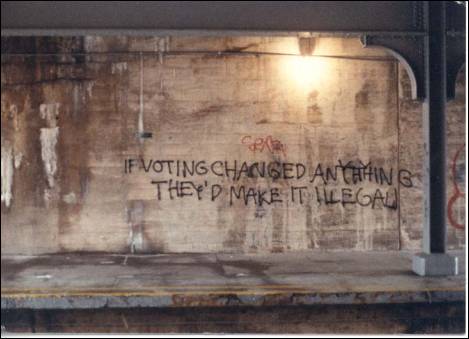
And nothing changes. Whether the government is from the left, or from the right the mechanism remains the same. The State, when at the mercy of the Mob and more importantly economic interests, will do nothing to change, or create instability. Two main factors are responsible for this. The first is the fundamental dynamic of democracy. People vote, governments are elected. Then the governments implement policies which will ensure they get reelected. The second factor is Big Business which will try to maximise profits by putting pressure on governments to take steps in that direction.
Political entities will attempt to court, flirt with, bribe, threaten and do anything they can to ensure their voters make the right choice. They will do what the voters and corporations want rather than what they need, or is in the best interest for society. This means that a democratic government will not do radical, extreme things. They will not alter the mechanism of the State, reduce bureaucracy, increase citizen participation, reduce their own power, change the dynamics of neoliberalism in their countries because all this means instability and nothing scares investors, voters and corporations more that instability. Even the madness of Nazism was ultimately born from this (mostly corporate) need for stability. Radical transformations are the product of revolutions- or dictatorships.
Far from my intentions to suggest that totalitarian and authoritarian governments are our salvation. The only thing they are good for is the creation of sufficient material wealth for democracy to function properly. The number of rich nations that managed to achieve considerable wealth without a period of dictatorship in the last three centuries is limited to Switzerland and a handful of other microscopic European oddities. The birth place of the Industrial Revolution was absolutist Great Britain, the powerhouse of pre-World War One Europe was Imperial Germany, and Bolshevik Russia made more progress in 50 years of pretend-communist rule than it did in over a century under weak tsarist government.
Applying democracy like you apply your crayola on a map is stupid in the extreme. Democracy cannot make a poor country rich. This is the terrible tragedy of decolonisation. In Africa the Imperial Powers (France, the UK, Portugal etc) left their troublesome colonies with a copy of "Democracy for Dummies" and a number of interesting mass graves for forensic anthropologists in training to practice on. How thoughtful. Unfortunately for everyone involved some idiot had ripped out all the pages in the book and replaced it with one bad crayon drawing of a house with the caption: Demmocrasy mak U Hapy. Not helpful. And so the African nations had to try and sort out this democracy thing without the necessary economic background and support. Hence poverty, ethnic tension and general unpleasantness. Let us not even go into the Middle East where democracy has been flown in on the tip of a bayonet or in the warhead of a SCUD.
Nothing can be changed through democratic rule. But we are told we can and will: this is the Great Illusion which has kept the politically aware from actually changing anything. The best, brightest and most dedicated people are sucked into this Illusion. Their attempts at reform are steadily absorbed into the Process, integrated into the System and thrown into the Chasm of Power, where all good intentions come to die. Political activists are told join the system, to integrate. They are encouraged to change things from the inside. Ultimately their dreams are dashed in between the dual hammers of Partisan Politics and Power Play.
This mechanism is not an accident of the evolution of Power, Politics and the State. The systematic suppression of any form of radical change, whether it be at the hands of ambition, greed or sheer bureaucratic momentum is as carefully crafted as the most intricate watch. As tension rises throughout society, as change is called for, the Powers that Be carefully listen to the ticking, to see when the spring is sufficiently wound up. And that the opportune moment they will use the spring's energy to propel themselves further. They will do this by offering government jobs, integration into the political process funding for yet another political party or integration into a preexisting one. And little by little the energy, vigour and strength of revolution is integrated into the steady clockwork of the Watch. And no one, not the cogs or the spring or even the hands of the watch realise what is occurring.
Religion may be the opium of the masses, but democracy is our Vicodin.
At least this is the vision that the Fearless Leaders of this world would have us believe. And for a hundred years we have (mostly) been inclined to believe them. Capitalism and the incredible growth it brought to the European Powers and the United States seemed to go hand in hand with the growth of liberal democracies. Indeed the relation that we have been taught to believe is: More Democracy EQUALS More Wealth.
This idea was reinforced and, to a large extent, created by the necessity of the Cold War as Western (Liberal Capitalist Democratic) Powers battled with the 'Evil Empire' that was the bloc of 'Communist' countries. So much relentless propaganda was pumped into the civilian populations of the 'West' that eventually they actually came to believe it. The current generation of World Leaders are direct products of this propaganda. The result is disastrous.
Democracy has come to be seen as a miracle cure to poverty, economic stagnation and Islam. This is part of the pipe-dream we were discussing earlier. The perceived outcome of this delusion is that the absolute application of liberal democracy in all countries will create wealth, like some kind thermodynamically impossible horn of abundance. The truth is that democracy is an excellent system- for keeping things the same.
In our liberal bourgeois - to use the Marxian term - democracies governments come and go, laws are passed, senators, members of Parliament and congressmen/women elected from a myriad of parties (or not) and-
And nothing changes. Whether the government is from the left, or from the right the mechanism remains the same. The State, when at the mercy of the Mob and more importantly economic interests, will do nothing to change, or create instability. Two main factors are responsible for this. The first is the fundamental dynamic of democracy. People vote, governments are elected. Then the governments implement policies which will ensure they get reelected. The second factor is Big Business which will try to maximise profits by putting pressure on governments to take steps in that direction.
Political entities will attempt to court, flirt with, bribe, threaten and do anything they can to ensure their voters make the right choice. They will do what the voters and corporations want rather than what they need, or is in the best interest for society. This means that a democratic government will not do radical, extreme things. They will not alter the mechanism of the State, reduce bureaucracy, increase citizen participation, reduce their own power, change the dynamics of neoliberalism in their countries because all this means instability and nothing scares investors, voters and corporations more that instability. Even the madness of Nazism was ultimately born from this (mostly corporate) need for stability. Radical transformations are the product of revolutions- or dictatorships.
Far from my intentions to suggest that totalitarian and authoritarian governments are our salvation. The only thing they are good for is the creation of sufficient material wealth for democracy to function properly. The number of rich nations that managed to achieve considerable wealth without a period of dictatorship in the last three centuries is limited to Switzerland and a handful of other microscopic European oddities. The birth place of the Industrial Revolution was absolutist Great Britain, the powerhouse of pre-World War One Europe was Imperial Germany, and Bolshevik Russia made more progress in 50 years of pretend-communist rule than it did in over a century under weak tsarist government.
Applying democracy like you apply your crayola on a map is stupid in the extreme. Democracy cannot make a poor country rich. This is the terrible tragedy of decolonisation. In Africa the Imperial Powers (France, the UK, Portugal etc) left their troublesome colonies with a copy of "Democracy for Dummies" and a number of interesting mass graves for forensic anthropologists in training to practice on. How thoughtful. Unfortunately for everyone involved some idiot had ripped out all the pages in the book and replaced it with one bad crayon drawing of a house with the caption: Demmocrasy mak U Hapy. Not helpful. And so the African nations had to try and sort out this democracy thing without the necessary economic background and support. Hence poverty, ethnic tension and general unpleasantness. Let us not even go into the Middle East where democracy has been flown in on the tip of a bayonet or in the warhead of a SCUD.
Nothing can be changed through democratic rule. But we are told we can and will: this is the Great Illusion which has kept the politically aware from actually changing anything. The best, brightest and most dedicated people are sucked into this Illusion. Their attempts at reform are steadily absorbed into the Process, integrated into the System and thrown into the Chasm of Power, where all good intentions come to die. Political activists are told join the system, to integrate. They are encouraged to change things from the inside. Ultimately their dreams are dashed in between the dual hammers of Partisan Politics and Power Play.
This mechanism is not an accident of the evolution of Power, Politics and the State. The systematic suppression of any form of radical change, whether it be at the hands of ambition, greed or sheer bureaucratic momentum is as carefully crafted as the most intricate watch. As tension rises throughout society, as change is called for, the Powers that Be carefully listen to the ticking, to see when the spring is sufficiently wound up. And that the opportune moment they will use the spring's energy to propel themselves further. They will do this by offering government jobs, integration into the political process funding for yet another political party or integration into a preexisting one. And little by little the energy, vigour and strength of revolution is integrated into the steady clockwork of the Watch. And no one, not the cogs or the spring or even the hands of the watch realise what is occurring.
Religion may be the opium of the masses, but democracy is our Vicodin.
Subscribe to:
Posts (Atom)